A potpourri of life and what to do when it hands you lemons, fruits, & nuts!
Sunday, October 28, 2007
"Chocolate Cream Pie"
Friday, October 26, 2007
Fleur-de-lis
I remember when our cousin had her first house built and it came time for the wallpaper to be put up. She came home early one afternoon to discover that the paper hangers had put her new wallpaper upside-down. The paper hanger looked at it and remarked, "Are you sure, ma'am? It looks okay to me." Our cousin looked at him, laughed and said, "It's a fleur-de-lis -- a flower -- you hung it upside-down!" Needless to say, the paper hanger had to remove and re-hang the wallpaper. Then, it was a perfect fleur-de-lis wall hanging.
This information was obtained from: http://en.wikipedia.org/wiki/Fleur-de-lis
Wednesday, October 24, 2007
Nothing Like that Good Old Flavor!
Recorded by: "Lonnie Donegan & His Skiffle Group"
Indian Corn . . . Questions & Answers
Q: Why is Indian corn inedible?
A: April Holladay checked with Eckler Farms to see if it is customary to shellac or treat decorative corn and, thereby, make the corn inedible. "We don't do anything to our corn but pull back husks and remove the silks. It is all natural stuff," says Larry Eckler. "All you need to do is wash it off with water like you would any other vegetable." [However, stay clear of corn used in potpourri mixes, because those things have added fragrances.]
Q: Can Indian corn be grown and eaten?
A: Indian corn can be grown. Eckler Farms sells seeds or seeds can be purchased at your local nursery.
Q: How did Indian corn get its name and why are the kernels hard?
A: Indian corn got its name from Central and South American Indians who first cultivated corn at least 5,600 years ago. Why it is hard? Unlike the sweet corn we usually eat, the exterior of flint-corn kernels is hard and completely encloses the soft starchy part (the endosperm). Sweet corn kernels have a soft exterior as well as a soft, starchy inner part.
By the way, Eckler suggests popping mini Indian corn. "It's really good."
Further Reading:
The different kinds of corn, The International starch institute
How Indian corn defies Mendel's principles of genetics, by N.V. Federoff and Wayne's Word, an online textbook of natural history, Palomar College
Why Indian corn is colored by April Holladay, WonderQuest
Gourds, Indian corn, seeds and fall decorations by Eckler Farms
Grain Basics - Bulghur or Bulgur or Bulgar or Burghul = Cracked Wheat?
So, which it is, anyway? For one, who has grown up with this grain, I always thought it was the same thing, too, because elders used one for the other! Confused? Read on ...
Also known as burghul, bulger, bulgar, wheat groats (Arabic, Armenian, Turkish, British) bulghur is known by other iterations such as bourgouri or balgour. Kernels of whole wheat are steamed, dried and then crushed to make bulghur. The process involved to make bulghur is what gives it a fine, nutty flavour. It requires no or little cooking. Though modern processes involve oven drying or roasting some villages still sun dry bulghur on their rooftops.
Ancient Romans called bulghur cerealis, Israelites degan, and in some Middle Eastern regions it is still called arisah, translated by Biblical scholars as 'the first of the coarse meal' and was originally prepared as a porridge.
What is the difference between bulghur and cracked wheat? It is a matter of splitting hairs, or rather the wheat berry in one or the partially hulled wheat grain in the other and whether the cracking took place in a raw stage (cracked wheat) or after cooking then drying (bulghur).
Partially hulled whole wheat kernels that are soaked, then steamed (hence pre-cooked if you will), dried and then crushed are called bulghur. Because the process is more involved, bulghur is the more expensive product and is more tender than cracked wheat. It has a pleasant chewy texture, is easier to digest and for most of us, is tastier. Confusingly, some sources use wheat berries to make bulghur. What differentiates the two is that bulghur is soaked, steamed/cooked BEFORE the cracking. This difference gives bulghur a far longer storage life than cracked wheat.
Are they interchangeable? This depends on whether the recipe requires cooking or not and your own degree of purism. A salad recipe such as tabooli is uncooked, and so requires true bulghur as do recipes where bulghur is brought to the boil, cooked for a moment then left to rest off heat to swell as in a pilaf. Recipes requiring longer cooking times or coarse grain bulghur can be replaced with cracked wheat, but will need more cooking time.
Suppliers in Northern America are inconsistent in their product descriptions but most bulghur found there is actually cracked wheat. Visit a Middle Eastern food shop for the real thing! Just mention you want to make tabooli (or taboule) and you will surely be handed bulghur.
By the way, being of Near/Middle Eastern heritage does not make one an expert on the differences either. Many are not aware of a difference in the first place having spent their lives outside of the country of origin, are generations removed or, living in it still, only know what is locally used.
Now you know. Bulghur and cracked wheat - both are forms of processed wheat, yet the twain does not meet, or just barely?
Monday, October 22, 2007
An Apple a Day...
Sunday, October 21, 2007
Yummy Pumpkin Treats... M'm, M'm, Good!
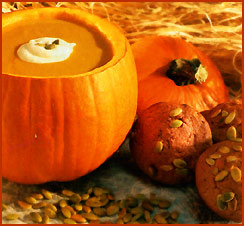
Yesterday, [for all practical purposes], talking about pumpkins made me think of all the good things that one can do with pumpkins. They can be used as decorative objects by just setting them down on your steps along with your choice of mum plants or branches of Autumn leaves, or just to by themselves. They can be carved into jack 'o lanterns, or one can paint a jack 'o lantern or "silly" face on the pumpkins. We know they can be used as vases for flowers, or how about bowls for a dip or to hold other edibles of one's choice. Pumpkins can have their seeds scooped out, washed, cleaned to separate, then roasted and salted for pumpkin seed snacks. How about just peeling off their skin and cutting up their flesh to cook by baking or simmering on the stove top until tender, then mashed to eat as a vegetable, seasoning it however you wished. You could add some apple slices, which have been sauteed in a little butter and brown sugar, and sprinkled with cinnamon or pumpkin pie spice. Another delicious way to enjoy pumpkin is in a smooth and creamy soup. Then, there are the other popular uses, such as in pumpkin pies, quick breads, cookies, cakes, cheesecakes, scones, muffins, pancakes, [or "crumpets"?], jam, or just preserved pumpkin slices or chunks. Can you think of anything else that I might have missed? Perhaps you might enjoy the following pumpkin treats:
In a medium saucepan, over medium heat, melt the butter. To the melted butter, add the chopped onions; sauteeing until gently browned. Add the mashed pumpkin, salt, sugar, nutmeg, and pepper. Slowly add the broth and heat thoroughly; DO NOT BOIL. To serve, pour into a tureen and add the cream.
4 eggs
1 cup vegetable oil
2/3 cup water
3 cups white sugar
3 1/2 cups all-purpose flour
2 teaspoons baking soda
1 1/2 teaspoons salt
1 teaspoon ground cinnamon
1 teaspoon ground nutmeg
1/2 teaspoon ground cloves
1/4 teaspoon ground ginger
Preheat oven to 350 degrees F (175 degrees C). Grease and flour three 7x3 inch loaf pans.
In a large bowl, mix together pumpkin puree, eggs, oil, water and sugar until well blended. In a separate bowl, whisk together the flour, baking soda, salt, cinnamon, nutmeg, cloves and ginger. Stir the dry ingredients into the pumpkin mixture until just blended. Pour into the prepared pans.
Bake for about 50 minutes in the preheated oven. Loaves are done when toothpick inserted in center comes out clean.
Saturday, October 20, 2007
The Artful Pumpkin
Friday, October 19, 2007
Marvelous Mums!
By Carol Stocker, Boston Globe Correspondent - October 18, 2007
Tuesday, October 16, 2007
Thought for the Day ... Crackpots!
* * * * *
Have you ever thought about the word, "crackpot"? Usually, one would hear this derogative term used for someone else who is a little odd, crazy, a curmudgeon, etc. I looked up the word on Google and found about 10+ pages on "CRACKPOT" ... WOW! Most entries seem to be names of restaurants or relating to books and so forth but, I was just curious to see what I could find on the word. Now, you might be thinking, "What does this have to do with flowers or flours?" Well ... you'll see! Anyway, here are my two favorite: a definition and a description follow:
* * * * *
From Wikipedia, the Free Dictionary:
Crackpot most generally means a capriciously eccentric person.
In various other uses, the term can mean:
Pejoratively, the term Crackpot is used against a person, subjectively also called a crank, who writes or speaks in an authoritative fashion about a particular subject, often in science or mathematics, but is alleged to have false or even ludicrous beliefs.
* * *
From Wikipedia, the Free Encyclopedia:
Crackpot is a village in Swaledale, North Yorkshire, England. Its name derives from the Old English kraka (a crow) and the Viking word pot (usually a cavity or deep hole often in the bed of a river, but in Crackpot's case it refers to a rift in the limestone). Crackpot cave contains a fine example of a column - where a stalactite has joined up with its stalagmite. To get to it you have to pass along the aptly named knee-wrecker passage.
* * * * *
Now, let's go on to a nice little story about, what else, "crackpots"! This may be a familiar story, but it's something to always keep in mind ...
THE CRACKPOTS!
An elderly Chinese woman had two large pots, each hung on the ends of a pole which she carried across her neck.
One of the pots had a crack in it while the other pot was perfect and always delivered a full portion of water.
At the end of the long walks from the stream to the house, the cracked pot arrived only half full.
For a full two years this went on daily, with the woman bringing home only one and a half pots of water.
Of course, the perfect pot was proud of its accomplishments.
But the poor cracked pot was ashamed of its own imperfection, and miserable that it could only do half of what it had been made to do.
After two years of what it perceived to be bitter failure, it spoke to the woman one day by the stream.
"I am ashamed of myself, because this crack in my side causes water to leak out all the way back to your house."
The old woman smiled, "Did you notice that there are flowers on your side of the path, but not on the other pot's side?"
"That's because I have always known about your flaw, so I planted flower seeds on your side of the path, and every day while we walk back, you water them."
"For two years I have been able to pick these beautiful flowers to decorate the table. Without you being just the way you are, there would not be this beauty to grace the house."
* * *
Each of us has our own unique flaw. But it's the cracks and flaws we each have that make our lives together so very interesting and rewarding. You've just got to take each person for what they are and look for the good in them.
* * *
SO, you see, my dear crackpots, "FLOWERS" did get into my message, afterall!
Enjoy this beautiful day and don't forget to stop and smell the flowers on your side of the fence!
Monday, October 15, 2007
The "Lady" -- A Sign of Peace, Tranquility, and Hope
However, getting back to the Lady of Fatima, on Saturday evening at 6:30, there was a service at the Fatima Shrine of the Xaverian Missioners in Holliston. The church service was held inside, which is a very small space and it was filled to capacity. Following the church service, there was a parade (for lack of a better term) to the "Lady". We all got our candles which lit our way from the shrine to around the large stone rosary, where the rosary was prayed, to the entrance of the statue of the "Lady". I attended the service with, again, my Portuguese friend who, by the way, is a great believer in the Lady of Fatima because she feels that this saint has helped her in many ways during her longtime illness. There were many nationalities at this service: Portuguese, Italian, Vietnamese, African, Polish, German, Indonesian and all of these people said the Ave Maria in their own language. It was a very nice and uplifting experience for me.
I had never been to a religious service at the shrine, although, I have gone there many times to accompany my friend when she felt that she needed to see the "Lady" for whatever reason.
If you've never been to the Fatima Shrine in Holliston, you should go, not necessarily to a church service -- (although the shrine is open for prayer and to light candles) -- but, if you would like to go for a nice walk (good exercise) and to just feel the peace and tranquility in the beautiful surroundings of statues, trees, flowers, candles, and a gift shop, then, go for it!
Wishing you a day of peace, tranquility, and hope!
Saturday, October 13, 2007
Simple Thoughts...
The heavens tell of the glory of God.
The skies display His marvelous craftsmanship.
-- Psalm 19:1
* * * * *
From the time the world was created, people
have seen the earth and sky and all that God made.
They can clearly see His invisible qualities
-- His eternal power and divine nature.
So they have no excuse whatsoever for not knowing God.
* * * * *
from God's Little Devotional Book for Women:
"What sunshine is to flowers, smiles are to humanity.
They are but trifles, to be sure but, scattered along
life's pathway, the good they do is inconceivable."
A happy heart makes the face cheerful. -- Proverbs 15:13
Peace and happy weekend!
A Rhyme in Thyme!
Thyme is one of those pungent herbs that can be used in a variety of ways. First, we know that it can be used with some vegetables, soups, and stews. Thyme can even be used in biscuits and breads. I've been known to use flowering Thyme and other herbs in floral arrangements, too, because not only do they look pretty but there is that nice fragrance of the herb... especially if the arrangement is used in the kitchen... what better place to enjoy the fresh scent of herbs?
Here is the site if you want to know more about herbs: http://growingtaste.com/herbs/thyme.shtml
Cultivars
"This is another of those herbs (like basil, if to a lesser extent) that comes in a myriad varieties, including species within the genus Thymus--there are over a hundred, most of which, it seems, are offered by seedsmen--plus so-called thymes ("white thyme", which is just winter savory, "basil thyme", which is calamint, and many others) not in the Thyme genus. By associated flavor, one finds listed in seedsmen's catalogues plain, French, English, Lemon, Lime, Orange, Caraway, Oregano, Coconut, and doubtless by now more "thymes". And, like many other herbs, there is also a large trade in varieties intended soley for floral or decorative use to confuse any search."
Now, getting back to the rhyme part, which I had intended to do, in the first place. Remember, it's just me ... being silly!
Thursday, October 11, 2007
Just Hanging Around ...
I looked at him rather strangely and said, "What did you say? Are you talking to me?"
He looked at me quite calmly and stated, "No, I was talking to the plant and it told me that it wants to go out NOW!"
"Oh...," said I. "Funny... I didn't hear it say anything."
Says he, "That's because it was whispering to me. It knew you were busy and didn't want to disturb you."
As you can imagine, by this time, I'm beginning to worry.
Says he, "Do you know why it wants to go out NOW?"
"No, why?" said I.
As he looked at me with that "little twinkle" in his blue eyes he said, "Because it is IMPATIENS!"
It is, I must admit, a most beautiful, full, gorgeous, hanging Impatiens plant which has bright, glossy green leaves and eye catching coral-colored petals. [By the way, what you see is the exact color of our Impatiens!] It makes us "proud" to see what has become of this magnificent blooming wonder.
When it was first adopted, it was still very pretty, but a bit on the thin side and somewhat petite and, quite honestly, I wasn't sure if it would make it. Surprisingly, though, hubby has taken very good care of his little Impatiens by feeding it FAITHFULLY with love and his special TLC every other week.
Since a few of our nights have dropped their temperatures he, again, faithfully brings Impatiens inside where it can stay warm and cozy. In the morning, before hubby leaves for work, he takes his little Impatiens and puts it outside to hang around so that it can enjoy the warm Autumn sun.
We are hoping that the continuous feeding every other week, during the Winter season, will allow it to remain full and happy until it can go outside once again in the Springtime. For the Winter, I'll just let it hang around in front of the kitchen window where the sun brightly shines during the morning hours and into the early afternoon.
Wednesday, October 10, 2007
Speaking of Apples...
Baked Apple Pancake
Yield: 2 to 4 Servings
2 Granny Smith apples, peeled, cored, and thinly sliced
1/2 cup granulated white sugar
1/2 cup light brown sugar, packed
2 teaspoons ground cinnamon
1 cup milk
4 large eggs
1 cup all-purpose flour
Pinch salt
½ stick unsalted butter
Preheat oven to 425 degrees.
Spray a 10-inch cast-iron skillet with vegetable oil.
Toss apples with both sugars and cinnamon in a large bowl; set aside.
Mix milk and eggs in a blender or food processor;
add flour and salt and mix to combine.
*Melt butter in prepared skillet over medium heat.
Add apple mixture; cook, stirring often, until sugar melts, about 5 minutes.
Remove from heat and pour batter over. Bake until pancake is puffed
and golden, 20 to 30 minutes. Serve at once. ENJOY!
Variations:
Maple syrup can be poured over pancake; however, it really isn't necessary
with the apples, sugars, and spice.
*Lightly spray a pretty baking dish with vegetable oil; place cooked apples in dish;
pour batter over and bake as directed above.
The Autumn Leaves, Caress the Trees ...
I couldn't find the words that I was familiar with; however, I did find some lyrics to the song "Autumn Leaves" sung by Nat King Cole, lyrics by Johnny Mercer, and music by Joseph Kosma. Shall we begin...
Tuesday, October 9, 2007
They Cover the Ground in a Burst of Color!
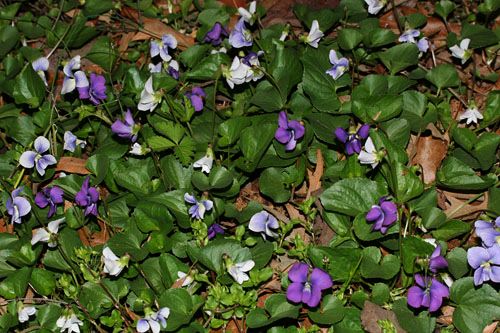
- Violets in deep purple and bright white. Lovely as a tiny bouquet OR if you get them at their peak, they can be "candied" to use on cakes and such!
- Buttercups -- in their bright and perky yellow color -- just put one under your chin and if your skin shows a yellow tinge then you like butter!!???
- Dandelions -- I know ... they are pesky little plants but I've been told that they are good for wine and salad, albeit with a rather bitter taste. Have you ever had Dandelion Wine? :(
- Burdock -- in case you are not sure about this one, it is fast growing green ground cover with tiny purple flowers. We checked this one out at Russell's Garden Center in Wayland and, yes, it is difficult -- if nearly impossible -- to get rid of this particular ground cover. However, that's the point, isn't it -- it's a "ground cover" -- don't most of want a good ground cover on bankings and such? The answer, of course, is an affirmative one BUT we do not want it to take over where the grass is supposed to grow!
- Wild Daisies -- they do pop up in the weirdest places but, then again, they're such happy and perky little flowers! Why bother to get rid of them?!!
- Other very tiny five-petal flowers -- not knowing what they are called -- in shades of hot pink, white, and yellow! Not enough to bother with ... once the lawnmower is in action, they disappear ... for a little while, anyway.
Well ... that about covers it!
Monday, October 8, 2007
In The Garden ... God's Misplaced Flowers
There were several titles I could have used for today's writing, however, I decided to choose this one as my first post. Why? I'm not really sure but, perhaps, we'll have come to a conclusion towards the end. Please bear with me ... I promise not to take up too much of your time.
Why is it that when you plant a particular type of individual flower or an attractive flowering bush and nurture and give it plenty of TLC, it does one of two things. First, if it's a good, healthy plant, it will do quite nicely in the special spot that you have chosen for it where it is bound to flourish. On the other hand, perhaps it may not be as healthy as you thought and, therefore, its leaves turn pale or brown, and fall to the ground, and the trunk withers and dries, and the plant dies.
Now, if we had a third side to the coin, it would be called: "The birds of the air..."! These graceful, songful critters have that magical side to them, where they eat the berries or seeds of a plant and then go on their way and, in time, 'nature calls' and they leave the remnants of their snacks ... wherever! [Remember Jack and the Beanstalk?] Unfortunately, the ones that land on my car, do not usually sprout! However, and eventually, the ones that land in my garden do sprout. I could really grumble and complain about it and go ripping these weeds [God's misplaced flowers] out of the ground only to throw them into the rubbish heap but, instead, we allow them to grow. Due to a natural curiousity factor, we like to see what may come of these little weeds. Usually and, in the end, we are a bit surprised to see what has enveloped from some of these seedlings.
Some of the lovely flowers and bushes that have emerged from these seedlings, in my garden, are:
- Honeysuckle -- Those fragrant orangy-yellowish blossoms that brighten any part of a garden. [Unfortunately, these little beauties grow with rampant vengeance and they are difficult to ... ahem ... thin out!]
- Queen Anne's Lace [or with the likeness of] -- Those gorgeous, large round, lacy-looking, white flowers that can be found by the side of the road or in certain areas of the garden [again, wherever]. They look pretty in bouquets or just by themselves in a tall vase with some greenery.
- Sweet William -- Tiny, velvet-like petals, that are bright and happy on their pretty green foliage. These little flowers happen to be the color of claret wine and make a perky addition to a smallish rock garden.
- Bittersweet -- In the Spring, the bright, shiny, green leaves grow abundantly on their woody stems and, after a wait, the Summer brings forth green berries. Going into Autumn, the berries begin to turn to a yellowish-orange color and the leaves begin to fall. Towards the end of Autumn, the berries begin to live by themselves on their woody stems, while their orangy color grows more and more intense. As Winter approaches, the berries are a bright and beautiful orangy-red, hence, the name Bittersweet. In New England, these gorgeous berries show their true beauty when they are against a backdrop of snow!
- Elderberry Bush -- One could get a great crop of berries for jam or wine, that is, if one can get to them before the birds!
- Thistle -- "The Campbells are coming, ho-ho, ho-ho! ..." I love Thistle, even though it's a prickly lad or lassie but, gorgeous, nontheless. It boasts pretty pinky-purplish flowers and grayish-green foliage ... and, let's not forget those thistles ... "Ouch!"
- Heather [or a similar garden variety of the plant] -- "I'll take the high road and you'll take the lo' road, and I'll be in Scotland 'afore ye ..." You know the one I mean ... again, it's that similar pinky-purplish color like it's cousin, Thistle, except the flower is a bunch of tiny flowers grown on a stalk. In my experience, this "Heather" tends to grow in wetlands near brooks or marshy areas and the flower grows with other tall grasses. I think the "real" Heather is also grown on tall stalks, except the tiny flowers are much firmer and sort of roundish, compared to the former description above.
- Wild Flowers -- We have a wild Rose bush, which grows among two small Elm trees. Its flowers are a creamy white but, like the thistle, watch out for those thorns ... too many ouches! Other wild varieties emerge from the banking and I do not know what they are called! Viny clusters that cling and wind themselves around anything in their way. Some have tiny bluish-purple flowers, some have white, some are bell-shaped, while some are stalky and others are short. We leave them, though, for they are a sanctuary for God's other creative critters, like butterflies, dragonflies, and bees.
- The Mystery Tree -- No ... that's not it's "real" name! Actually, I don't know what it's called. However, I can tell you that it has bright and shiny green leaves on top and the underside of the leaves are silvery. During the Spring and into Summer, the leaves flourish and grow faster than we can trim them! Now, towards the Autumn, little green berries begin to emerge and by Winter, these berries will be colored a pretty, deep, rich red. Again, no matter what time of the year, in its growing season, its branches offer a dense filler for flower arrangements, whether set in oasis or in a vase.
I think this covers my first post. I don't think I left out any of God's misplaced flowers. I think I got them all -- at least in my garden! What's in your garden?
Blog Archive
-
▼
2007
(21)
-
▼
October
(18)
- "Chocolate Cream Pie"
- Fleur-de-lis
- Nothing Like that Good Old Flavor!
- Indian Corn . . . Questions & Answers
- Grain Basics - Bulghur or Bulgur or Bulgar or Burg...
- An Apple a Day...
- Yummy Pumpkin Treats... M'm, M'm, Good!
- The Artful Pumpkin
- Marvelous Mums!
- Thought for the Day ... Crackpots!
- The "Lady" -- A Sign of Peace, Tranquility, and Hope
- Simple Thoughts...
- A Rhyme in Thyme!
- Just Hanging Around ...
- Speaking of Apples...
- The Autumn Leaves, Caress the Trees ...
- They Cover the Ground in a Burst of Color!
- In The Garden ... God's Misplaced Flowers
-
▼
October
(18)