A potpourri of life and what to do when it hands you lemons, fruits, & nuts!

Friday, November 23, 2007

In Sweet Memoriam...

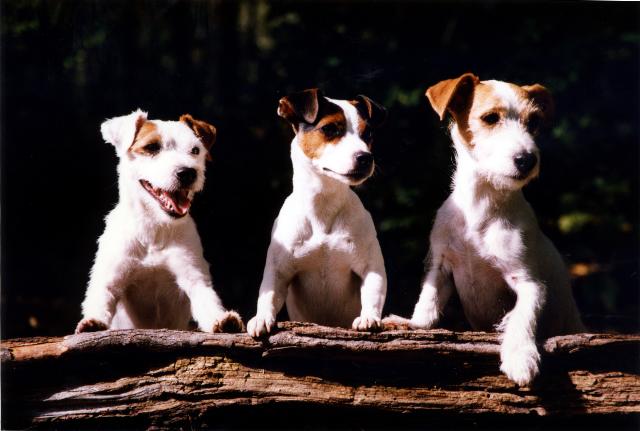
The little dog to the left is the closest image of our Phoebe. Just like this little pupper, she was always SMILING!!!
I have been putting off writing for several days because there is much sadness in my heart. Last week, family members had to say "good-bye" to our favorite little dog, Miss Phoebe Alouisius, who was 16-1/2 years old. Some would say that it's 'just an animal' but, to us, she wasn't just any animal; rather, she was one of the girls.
Whenever there was a gathering of the girls, she would be directly at our side, especially at the breakfast, lunch, or dinner table. She would make it a point to come sit by me --[she knew me as Dibley -- long story -- don't ask!] -- and look up with those big brown eyes. Uh-huh -- she was right there, just waiting for that little crumb to drop to the floor. Sometimes, she would have to wait quite a bit and that would be annoying to her, as she would "stamp" her little paw, as if to say,


"Hello, Dibley ... don't forget ... I'm down here waiting ... don't forget about me ... where's that crumb of food you promised me ... we can get away with it ... just drop it quickly ... mommy won't know ... she'll never know what hit the floor because it'll be gone faster than she could ever find it ... don't worry, I'll get it ... I'm a fast gobbler ... c'mon ...! WOW! It's about time ... oh goodie ... that was yummy ... can I have more?"

Phoebe and I had our own communication and she loved to play. The minute she saw me coming, first she would stick her nose into my bag to see [or sniff] if I brought her a treat or a toy. Then, satisfying that curiousity, she would run to her "toybox" and find a toy that we could play "tug-of-war" with and, usually, she would win ... a very strong little dog, indeed! She liked to wear her pretty leash and allow us to take her for walks. Actually, she would take "us" for walks ... not the other way around. She knew the way to go and we just followed. She liked to go to the playground where she could run free and we would play ball. Sometimes, she would tease us and hold on to that ball as if to say, "I dare you to take it away!" Her traits were better than most humans because she was quiet and never barked back, friendly and loyal, playful and affectionate, clever and determined, and totally independent!


For 16-1/2 years, she entertained us with her playfulness and special kisses and her love of human kind ... well, most human kind. Phoebe could be very aggressive towards other dogs, especially, smaller ones like herself. She was a brave little dog but always thought that she was one of the bigger dogs and wasn't afraid of being aggressive with them, either!
There will always be other little dogs, but there will never be another Phoebster. She truly was one-of-a-kind ... a very special little Jack Russell Terrier ... in all of her scruffiness! Her sweetness will always remain in our hearts.

Saturday, November 10, 2007

Gobble ... Gobble ... Talking Turkey!


Names for a Much-travelled Bird
-- by Michael Quinion
[Mr. Quinion writes on international English from a British viewpoint.]


About 1530, a new dish began to be put on English tables, a fowl a little larger than the traditional goose, but with a lot more meat and a refreshingly new taste. This bird had been brought to England by merchants trading out of that area of the eastern Mediterranean called the Levant but whom the English called “Turkey merchants” because that whole area was then part of the Turkish empire. The new bird was therefore called a “Turkey bird”, or “Turkey cock”. Within a few years it had become a favourite and familiar domestic fowl, to the extent that, sixty years later, Shakespeare knew his groundlings would understand the reference to the turkey’s aggression display of blowing out its breast and strutting when he described the posturings of Malvolio in Twelfth Night:

SIR TOBY BELCH: Here’s an overwheening rogue!
FABIAN: O, peace! Contemplation makes a rare turkey-cock of him; how he jets under his advanced plumes!

The interesting thing about the mistake over the turkey’s origins is that the English were the only people to believe they came from Turkey; nearly everyone else, including the Turks, thought they originated in India, or at least in the place they then thought was India. Turkeys actually came from Mexico and were first brought back from there about 1520, at a time when that area was called The Spanish Indies or the New Indies, illustrating the confusion in people’s minds about the true location of this new land that Columbus had found. As a result, a lot of European languages, as well as others like Arabic and Hebrew, called it something like the “bird of India” (for example, indianischer Hahn in old German).

But in a few languages, including Danish, Dutch, Finnish and Norwegian, the bird was named instead as coming from Calicut (Dutch kalkoense hahn, Danish kalkun), which is a seaport on the Malabar coast of India, the same place after which calico is named. As the turkey didn’t reach India for about a hundred years after its European introduction and naming, this looks mysteriously specific. But there may be an explanation. The turkey was introduced into Europe only about twenty years after the Portuguese explorer Vasco da Gama had pioneered the route round the Cape of Good Hope, up the east coast of Africa and across to India, where he landed in 1498 — at Calicut. It could be that people made the connection “bird of India” = “bird of Calicut” because they had heard about the Portuguese explorations and mistakenly thought the bird had been brought back from there, instead of the New Indies.

To compound the difficulties the English had with this immigrant, at about the same time, the 1530s, Portuguese merchants reintroduced the guinea-fowl from West Africa, which had last been seen in England at the time of the Romans. As it was the same Levant merchants who brought this into the country, the guinea fowl was also known for a time as the Turkey bird, though this confusion didn’t last long. For example, the heraldic arms granted to William Strickland in 1550 featured “a turkey-bird in his pride proper” and the bird shown is quite definitely a proper turkey. The only surviving instance of this confusion between the turkey and the guinea-fowl — but it’s a big one — was caused by Linnaeus; when he invented the new generic name for the turkey and its relatives he called it meleagris, which had been the name in classical Rome for ... the guinea-fowl.

As an aside to this, and to illustrate the total confusion over its origins by everyone, when the turkey did arrive in India, it was brought there via the Spanish possessions in the East Indies, and one name for it was the “Peru bird”, most probably because that was what the Portuguese, with their strong colonial presence in India, called it; still quite wrong, because there were no turkeys in Peru, but at least they had the right area of the world.

And the domestic turkey was re-introduced into North America from Britain, taken there circuitously by the colonists of New England and Virginia, who were surprised to find it living there wild. Benjamin Franklin once suggested its wild cousin should become the national bird of the United States. If of any country, it should be Mexico of course, but because of its wide travels and the total confusion over its origins, perhaps instead the turkey ought to be the official bird of the world.

________________________________________


___________________________________________

Wishing You A Happy Thanksgiving With All Its Abundance And Blessings!

Thursday, November 1, 2007

Smile Pretty for the Camera!


Happy smiles to you! Aren't these the cutest little smilies you've ever seen? That's what I thought when I looked at them. Whoever knew that Orchids could smile like this? YES ... I did say, "ORCHIDS"! This photo for this particular strain of Orchid was taken at Tower Hill Botanical Gardens in Boylston, Massachusetts. Tower Hill is the headquarters of the Worcester County Horticultural Society, is located on 132 acres, and was established in 1986. To see the current events that are taking place at this breathtaking museum, you may check out their website: http://www.towerhillbg.org/ where you will find extensive information about their history, gardens, features, programs and other exciting events.

On a lovely Sunday afternoon in October, my husband and I went there and, of course, he is a photography hound, so he brought along his favorite, trusty camera and photographed some of the Orchid species that were being shown (with a little prompting by 'you-know-who' as to which ones he should concentrate on)! This darling species did so amuse me (but, it doesn't take much!) and I just had to have a photo of it. If you are ever in the area, do stop by and take a tour through the beautiful gardens, especially if the weather is agreeable. Otherwise, there are many plants, trees, shrubs, and other flowers that you can see indoors. They also have a lovely cafe that serves delicious meals and desserts and a terrific gift shop for those who like to poke about and shop.
Although we are members of Tower Hill, it is not necessary for anyone else to be a member. However, if you do decide to take a yearly membership, it will be money well spent because after just a few visits, you have more than received back the money invested and rewarded yourself with knowledge, at the same time. You can even go there on a 'daily' basis if desired, even if it's just walking about the property, and reaping the benefits of some great exercise for your whole being!
CHEERS!